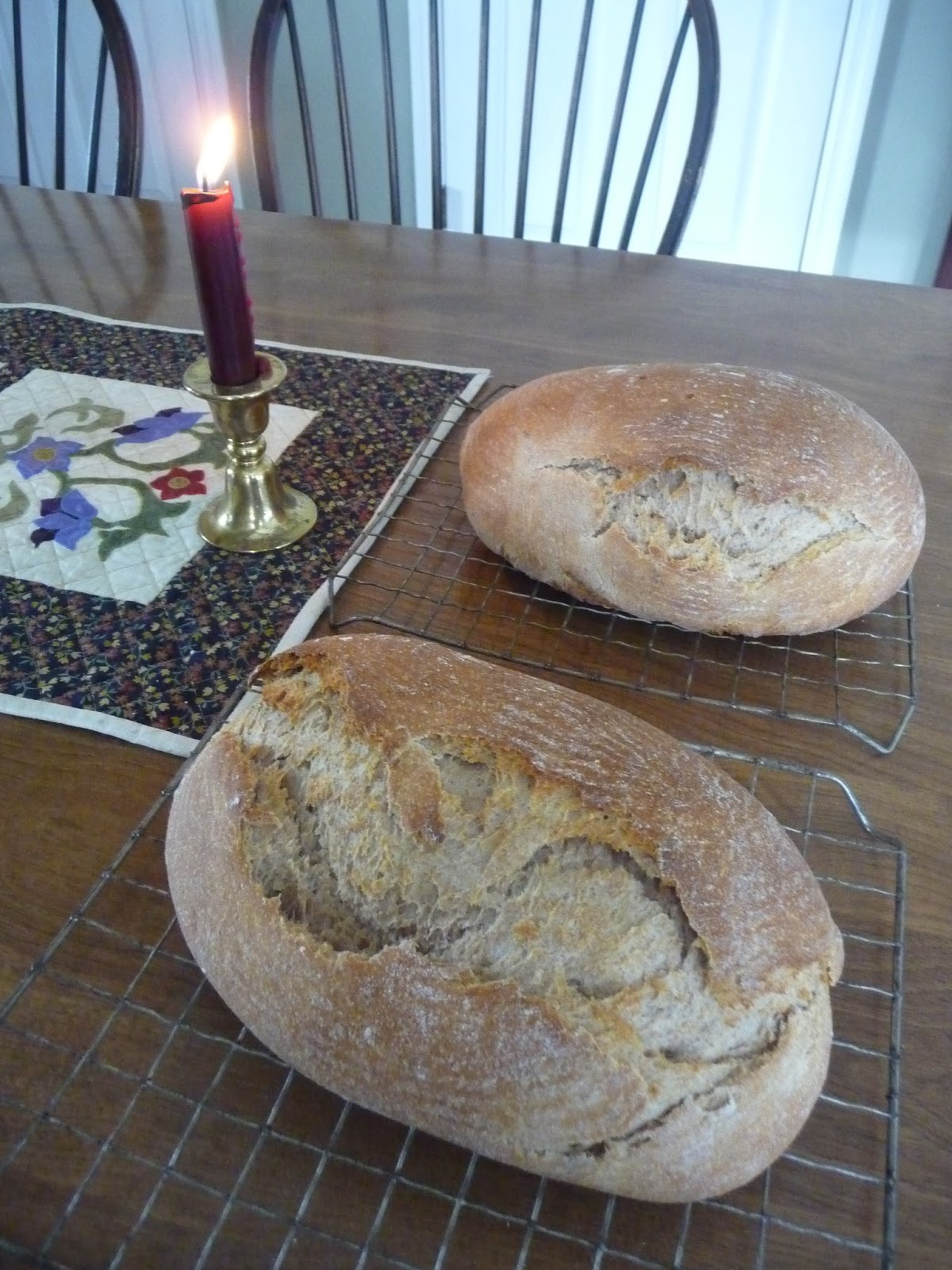
Tuesday, July 16, 2013

TWD -- A Half-sized Tart

A half-sized tart made with a pastry crust
What do you do when a recipe calls for phyllo dough and there is none to be had in the small town in which you live? Substitute. So my Summer Vegetable Tart was made with pastry dough, a supply of which I always keep in my freezer. And a 9" tart seemed awfully big for two people when the recipe appears to be one that needs to be eaten soon after it was made, not days later in the form of leftovers.

So I opted for a 7" tart instead and by cutting the recipe in half, everything worked out just fine. I followed the recipe exactly, but added a bit more thyme. I figured the small amount called for in the recipe once cut in half would be minuscule.

I started by blind-baking my crust, using dried beans as my pie weights. I keep a parcel of dried beans wrapped in foil on my baking shelf and use the same dried beans every time I need to blind bake.
Pie crust pricked with a fork
Using dried beans as pie weights
After letting the crust cool, I sauteed the vegetables, added the goat cheese and scooped the mixture into the cooled crust. I let the mixture cool to room temperature, then cut the tart into wedges and tried it -- delicious. I will definitely make this again, but experiment
with other vegetables. Like everyone else in my area of Ohio, I have a wealth of zucchini right now. I think I will cut back a little on the red pepper, keep the mushrooms and onion and add a handful of sliced zucchini.

Tuesday, June 18, 2013

TWD -- Galette: a wonderful invention


Swiss cheese, cheddar cheese and basil
This week's assignment for Baking with Julia, the tomato galette, was a joy to make and to eat. I do recall we made a galette last year and I remembered the dough was easy to make and to roll out. This time I used the food processor and made half a recipe. The dough appeared a little too wet in the beginning, so I added some additional flour.

Ready to pop in the oven
After letting the dough chill, I rolled it out using a pasty cloth and rolling pin cover. Oh, if all dough was so easy to roll!! I then transferred the rolled-out circle to a piece of parchment paper and began putting on the toppings. I used cheddar and swiss cheeses because that's what I had and I thought the combination would be good. We grow our own basil, so I snipped off a few leaves and tossed them with the cheeses.

The baked tomato galette
After applying the cheese/basil mixture, I lapped the Roma tomatoes in a circular shape as instructed, brought up the edges and pleated them, sprinkled on some Penzey's Tuscan Sunset herb mixture and popped it into the over for about 25 minutes. The taste was heavenly, and I will make this again before the summer is over. Our tomato season doesn't really hit here in Ohio for about a month, so I will be ready to go when the time is right.

Tuesday, May 21, 2013

TWD -- Brioche pockets to die for

Baked pockets ready to eat
I have a confession to make. I didn't use the brioche recipe in Baking with Julia. It looked like a heap of dough, so I debated cutting the recipe in half or consulting "Bernard Clayton's New Complete Book of Breads." If you are a break-baking enthusiast, this book is a bible and one that should be on your shelf. Clayton has a food processor brioche recipe that makes about half as much brioche as the Baking with Julia formula and is easy as pie to make.

1/4 cup warm water
1 package dry yeast
1 1/4 cups flour
3 tablespoons sugar
1/2 tsp salt
2 large eggs, room temperature
6 tablespoons butter, melted. 
Proof the yeast in the water. Put everything in the food processor with the steel blade except the eggs and butter. Pulse a couple of times to aerate. Drop in first the eggs and process about 5 seconds. Then pour the melted butter through the feed tube in a steady stream. Process 20 seconds. The dough is sticky, like batter, but that's OK. Scape dough in a buttered bowl and let rise about 3 hours. Then refrigerate.


From here on out, I followed the Baking with Julia recipe. I found the dough easy to work with and used a hamburger press to cut my rounds.

Brioche before seeding and baking

I stretched the top rounds a bit before placing them over the filling. The edges were easy to turn over and crimp. I did use the full filling recipe and if I had not, the pockets would have been scantily filled.

My version made eight pockets -- perfect for a back yard drinks party. Everyone loved the combination of the brioche dough, the caramelized onions, the potatoes, goat cheese and asparagus. I will definitely make this recipe again!

Tuesday, May 7, 2013

TWD -- Delicious but ungainly

The rhubarb upside down cake assignment for Tuesdays with Dorie couldn't have come at a better time for this Ohioan. Our rhubarb patch is at its peak, so there was no problem getting enough of the stuff for the upside down cake.

I debated whether to make this recipe using the baby cake pans, which my daughter kindly gave me for Christmas. However, I had four pans and the recipe called for eight cakes. The other option was to use the 12-inch skillet, which I happen to have and rarely use.

The recipe went together without a hitch. But getting the cake turned upside down using a 12-inch skillet was a feat that could only be accomplished with an assistant. Luckily, my husband was handy, and he helped me turn the ungainly pan upside down. However, with all our careful planning, the cake missed the mark by a couple of inches and some of the dessert was hanging over the edge of the plate and dangerously close to breaking off. By jerry-rigging a device using a spatula and two dough scrapers, I was able to prop up the cake until it cooled and I could gingerly shove it over until it rested securely on the cake plate. This took several attempts before I could manipulate the ungainly cake into a secure position.

The finished product after jerry-rigging and much manipulation
I will take this treat to the bakery where I volunteer and we'll serve it during our coffee break tomorrow. I must confess I snitched a wee bit of the cake and topping and it was delicious, perhaps the best yellow cake I have ever made. This will now be my go-to recipe for yellow cake, but when doing the upside down cake again, I would cut the recipe down by one-third and use a nine-inch skillet which would make it much, much easier to turn. Most of my recipes for pineapple upside down cake call for a nine or 10-inch skillet.

Tuesday, April 16, 2013

TWD -- Call me deviant

I confess. I deviated from the recipe for madeleines that was in Baking with Julia. When I saw that Baking with Julia was having us use the genoise recipe, I was suspicious. Although I would consider a madeleine a type of genoise, it is more than that. In my mind, a madeleine should have some baking powder (although I've read there is some disagreement about this), but should definitely have more butter. Three tablespoons of butter can nowhere be enough, when most recipes for 24 madeleines call for a stick and a half, or at the very least nine tablespoons. And, where was the flavor? I remember the genoise recipe as being bland, bland, bland. I wanted my madeleines to have a little kick to them.

So I began cross-referencing. I hauled down "Joy of Cooking" from the bookshelf. I consulted the book "Sweet Life in Paris." I looked at recipes on the internet, particularly Allrecipes.com, where I could look at user reviews.

Although the Baking with Julia recipe seemed to have odd proportions, it also had a major and unforgiveable error in my opinion. The recipe called for 1 cup of confectioner's sugar, yet nowhere did it say where or how the sugar was to be used. Where was the proofreader?! Where was the editor?! If the sugar was to be used as a dusting for the madeleines after they were baked, why one cup? It wouldn't take a cup of the stuff to dust 24 three-inch cookies. By this time I was quite distrustful of the printed recipe and decided to veer off in my own direction.

The madeleines before glazing
Thus, I combined the most popular recipe on Allrecipes.com (which incidentally used confectioner's sugar right in the mix) and the recipe from "The Sweet Life in Paris." The latter recipe called for the grated rind of a lemon, plus a lemon glaze. My combined recipes used a stick of butter for 19 cookies.

Ready to head out the door to the bakery
I was pleased with the results, and so were the volunteers at the bakery where I work who shared the end result. They loved the lemon flavor and thought the shape of the cookies were a joy. I then took a plate to two art teachers with whom I sew, and they liked them. And, one had a wonderful suggestion that I will use next time that I make these cookies. I will use a lavender glaze on them rather than a lemony one. Such a glaze can be made by steeping a little lavender in some hot water, then adding that to the confectioner's sugar. I use this glaze for a lavender pound cake that I make and it's nothing short of wonderful.

Monday, April 1, 2013

TWD-Potato bread made the hard way

Rustic Potato Bread ready to slice
The Rustic Potato Bread assignment came at a perfect time for me. I had just made my usual potato rolls for an Easter dinner using King Arthur's potato flour. These rolls are a standard, as is a white sandwich bread made with potato flour that I make when grandchildren are coming. Would Rustic Potato Bread made with actual potatoes be better and give off more of a potato flavor? I was curious to find out.

I decided to make my bread using two-thirds whole wheat flour and one-third white all-purpose flour. The mixing process was interesting to say the least. The dough appeared so dry at the beginning I was sorely tempted to add a lot of water to keep my Kitchen Aid mixer from having a heart attack. I resisted in adding a lot of water but did dribble in a few extra drops to help things along. I reasoned whole wheat flour might absorb more water than white flour. The dough seemed to come together and was cleaning the sides of the bowl, but after about eight minutes, it began to come apart, leaving small globules of dough on the side of the bowl. I decided to call the kneading process to a halt and gently hand-kneaded the dough until it felt right.

Rising in the baskets
I was a bit put off by the shaping technique of putting the seam of the bread right-side up. I had read in the comment section that one baker experienced an unraveling of sorts when the bread was baked, so I opted to let my loaves rise in baskets (obtained from my local drug store where I buy just about everything including most of our food because our town has no local supermarket).
Ready to go into the oven
The baskets allowed the loaves to rise with some support and when I turned them out on a cornmeal-dusted pizza paddle, they looked pretty good. Should I score them? There was nothing in the instructions that indicated scoring, so I didn't. I wish now that I had. The loaves burst open in places, which definitely gave them the rustic look.

Now, for the taste test. Were these loaves better than the bread and rolls I traditionally make with the addition of potato flour? Not really. Are loaves using potato flour easier and quicker to make? Yes, yes, yes. There is no cooking of the potato, no allowing the potatoes to cool and most of all, no anxious moments standing over the Kitchen Aid worrying that it might die. And did I mention that my husband had to hit the bowl with a mallet to get it to loosen from its base?

So, I will probably go back to my traditional method of making potato bread but I'm thankful for the experience of trying the real deal.

Tuesday, March 12, 2013

TWD -- Cookies that get raves!

I will be traveling during the normal time to bake the latest assignment for Tuesdays with Dorie, so I chose to make the mocha chocolate chip cookies 10 days ahead of schedule. I'm glad I did. That way I could offer the cookies to several people and get their reactions. In short, they got raves!

I used espresso powder which I had recently purchased from Jungle Jim's, the largest food market in the United States. The market is located in Hamilton County near Cincinnati, and for anyone living in the Midwest, I highly recommend a stop there. I never would have found espresso powder in my small town, but luckily I purchased a container at Jungle Jim's even before I knew I would need it for a Baking with Julia assignment.

When making these cookies again, I would alter the recipe slightly. I would up the amount of flour by one-fourth of a cup and I would substitute shortening for the butter. I know. I know. I can read the minds of all the butter aficionados out there who shudder at the thought of substituting shortening for butter. But, by using shortening, the cookies won't spread out as much. I, in fact, used half butter and half shortening when making the mocha cookies and now wish I had used all shortening. I like a chocolate chip cookie that you can really sink your teeth into -- think Otis Spunkmeyer. My favorite recipe uses two and a fourth cups of flour for the same amount of fat.

My cookies were made with two tablespoons of espresso powder, but next time I will up that to three tablespoons to get even a stronger mocha taste.

Would I make these cookies again? Yes, definitely, but with the aforementioned adjustments. In short, I would use the recipe on the box of Arm & Hammer baking soda with addition of three tablespoons of espresso powder. And I would bake them at 375 degrees for 11 minutes.